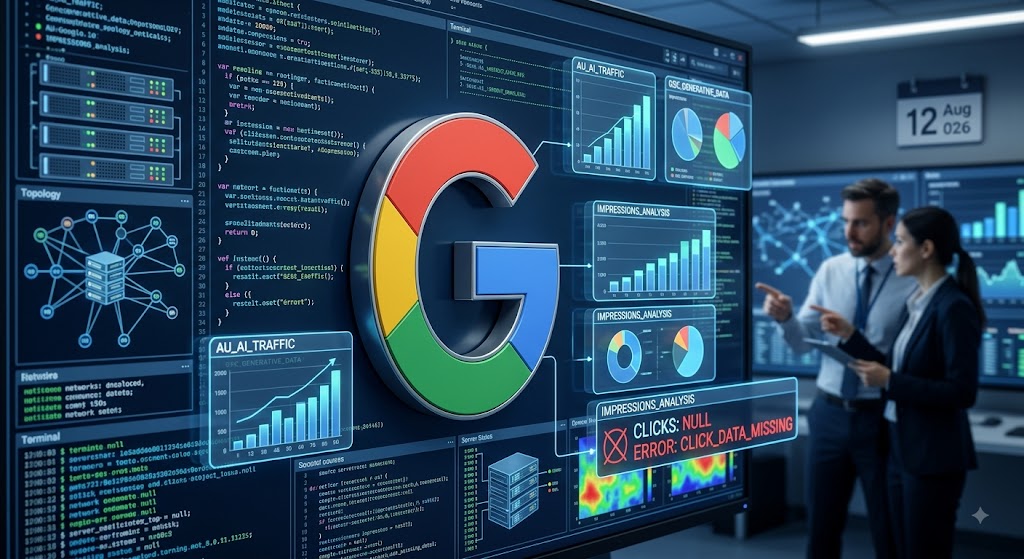
Today (12th August 2026) is a big day! Better late than never, Google just made Generative AI Data available to AU websites in Google Search Console, bringing them into line with Bing which has had this data available for months!
Digital marketers and SEO/AEO/GEO leaders finally have first-party data to evaluate how AI answers influence organic discovery. But Google is only one piece of the puzzle. To understand your brand's full footprint across LLMs—including ChatGPT, Copilot, Perplexity, and Gemini—you need a cohesive, multi-platform measurement framework.
Google Search Console - Generative AI performance report
Data Sources Included:
- AI Overviews,
- AI Mode,
- Gen AI features on Google Discover
Data Sources Not Included:
- Gemini
- Any other LLM or search tool
Data Points Included:
- Impressions
- Pages
- Countries
- Devices
- Days
Data Points Not Included:
- Clicks,
- Citation Share,
- Queries.
What Can I Use This Data For?
This report shows “how many times links to your site were shown to a user in a generative AI feature on Google Search” meaning you can now identify what content on your site is (and isn’t) most valuable and visible to users. This data can then be used as the starting point for identifying which content optimisations should be prioritised.
What Can’t I Use This Data For?
Because there is (currently) no click data, you can’t use this report to measure referral traffic to your site, identify which impressions generated value, or what queries generated the impressions. For that information, you need to reference the following.
Google Analytics AI Assistant Data (GA4)
Launched in May 2026, Google Analytics’ AI Assistant data automatically measures referral traffic originating from LLM platforms like ChatGPT, Gemini, Perplexity, and Claude.
Data Sources Included:
- ChatGPT
- Gemini
- Claude
- Copilot
- Perplexity
Data Points Included:
Data shows up in GA under:
- Default Channel Grouping as “AI Assistant”
- Source / Medium as (eg) chatgpt / ai-assistant
As this traffic is treated just like any other channel, standard GA Dimensions and Metrics can be used to analyse the traffic.
What Can I Use This Data For?
Just as you would any other traffic channel, you can use this data to evaluate the effectiveness of traffic from LLM sources and it’s value to your website.
Where Else Can I Find Data On My AI Visibility?
As with everything in the world of AI - change is fast and constant. As of right now, there is no “single source of truth” that will provide answers to your AI Visibility questions. In fact as of right now ChatGPT does not share any visibility data at all with publishers (though that may change as their ad platform develops) in the meantime data sources include:
- Bing Webmaster Tools - AI Performance Report - Bing beat Google to market by sharing visibility data from Copilot, Bing Summaries and partner AI integrations (but not ChatGPT)
- 3rd Party Traditional SEO Tools - eg SEMrush - provide visibility analysis, competitor research and prompt research metrics by prompt sampling and crawler tracking
- Emerging AI Specific tools such as Profound, Peec or Otterly - gather data through browser simulation, programmatic querying and UI-scraping agents.
The Bottom Line
We are one small step closer to having the tools to definitively measure the value of LLMs to brand visibility.
Bing was first to the party; now Google have followed suit. Will ChatGPT be the next domino to fall?