For two decades, search meant one thing. Ranking on Google, earning the click, converting the customer. Today the channel has splintered.
Search is no longer a unified channel dominated by a single destination. Instead, it’s rapidly fragmenting into an ecosystem where traditional search engines and generative AI assistants are influencing the buyer decision making process.
User behaviour has changed. AI-driven search experiences are becoming a default part of how people research and choose brands. In this article, we share how we at Sonar Group are adapting, what we are seeing across client data, and the strategies we are using to help brands thrive in this evolving search landscape.
The New User Behaviour: Consideration Without Clicks
Google has long been the dominant search engine accounting for more than 85% share of traditional search. But that dominance no longer tells the full story. New platforms such as ChatGPT, Gemini, Perplexity are expanding how users seek information, especially in the consideration phase of the customer journey
In fact, a survey by Mckinsey 2025 shows that users now ask AI for brand recommendations, product summaries, or evaluative advice
Real-world signals from Sonar Group reinforce this trend. Across Sonar’s home builder clients, we observed AI referral traffic grow over 158% year-on-year, with engagement rates at 76% and strong conversion outcomes, incremental to organic traffic. This suggests that while traditional search remains really important, AI referrals are becoming a distinct contributor to business outcomes, especially for our key aged care and home builder clients.
Trends in AI Search: AI-driven Platform Changes
Google AI Overviews & Google AI Mode Are Rewriting SERP Behaviour
Google’s AI Overviews (also called Search Generative Experience or SGE) synthesise answers from multiple sources directly on the search page. These summaries are increasingly prominent for informational queries, and when present, they significantly reduce clicks to traditional search results.
In late 2025, Google AI mode was also launched in Australia- a conversational search experience within Google Search, that generates detailed summaries, comparisons, and answers for complex queries directly on the search page similar to Chatgpt.
ChatGPT Ads recently launching
The commercial roadmap of AI search is rapidly growing. In early February 2026, ChatGPT is now testing native ad placements in the US tied to conversation context and user history, showing ads not by keywords but by intent and topical relevance for the free and go tiers in the Chatgpt market.
Chatgpt and Shopify Integrations
Similarly, the partnership between ChatGPT and Shopify to enable product purchases directly within the chat interface is a clear indicator that AI platforms are not just new search channels but also new conversion environments.
What It Means for Marketers And How to Respond?
1. Track AI Referrals and Citation Signals
Marketers should treat AI referral and citation data as distinct performance channels. Tools like Bing Webmaster’s AI performance dashboard can help quantify how your brand is being referenced in AI-powered experiences. Monitoring this alongside your AI referral traffic data from GA4 offers a fuller view of where demand is materialising.
At Sonar Group, we analyse AI referral traffic patterns, including queries where clients are cited, overall brand sentiment and conversions generated from AI traffic. We then build roadmaps for our clients to incorporate AEO/GEO into their media mix.
2. Embrace AI Search Ads: Chatgpt Ads
AI platforms’ advertising ecosystems such as ChatGPT’s contextual ad tests represent a new media channel. These placements are not tied to keywords but to topics and intent signals, which means marketers need to think differently about audience targeting and creative relevance.
3. Strong SEO Foundations Still Matter
The fundamentals of SEO- clear structure, fast pages, robust technical SEO, and great content remain essential. In fact, these fundamentals help ensure that sites are more easily parsed and indexed by AI systems that rely on structured signals and authoritative signals to select citations. At Sonar Group, we noticed that brands that perform well in SEO tend to have spill-over benefits in AI Search Visibility.
4. Design Content for AI-First Consumption
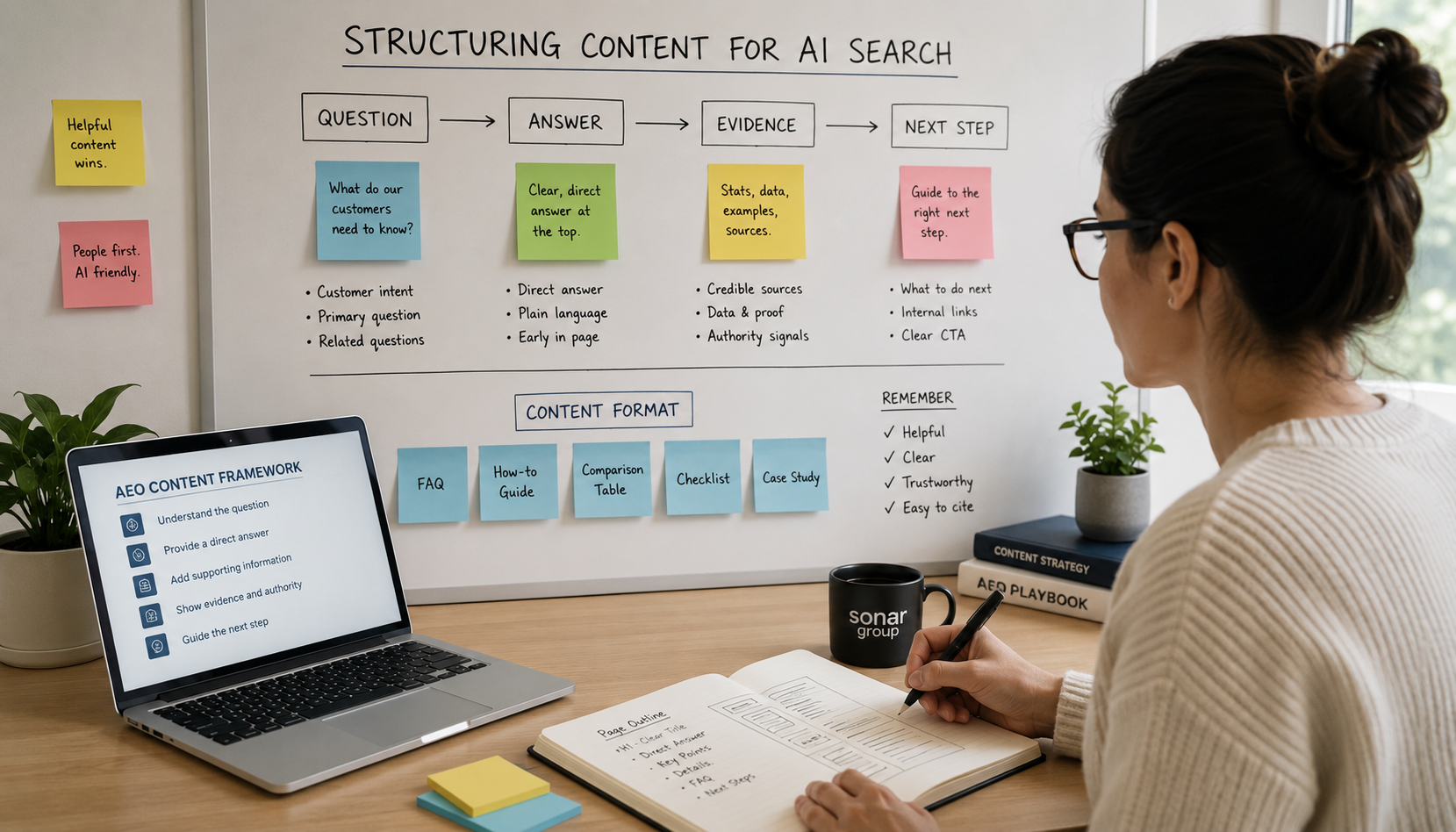
Traditional keywords and long-form guides still have value, but the future requires content that anticipates the needs of AI extractive systems. This means concise answers, clear signals, structured data, and authority cues that AI models can use to confidently cite your brand.
At Sonar Group, we often reverse-engineer query pathways used by AI platforms through a query fan out analysis- predicting likely extractive questions and mapping them to structured content blocks. Content that answers multiple intent layers from definition to comparison to purchase rationale is more likely to be surfaced in AI Overviews and chatbot responses.
5. Invest in Digital PR and Online Citations
AI systems select answers from a broad web of sources. Branded mentions, high-authority backlinks, and contextual citations across media roundups, listicles, and editorial content increase the probability of being included inside AI-generated responses (Semrush, 2025). Independent analysis finds that branded mentions and anchors are among the strongest predictors of whether a site appears within AI Overviews, reinforcing why link building and digital PR remain strategic priorities.
Conclusion: Search is Evolving and Becoming Multidimensional
The search ecosystem is fragmenting. A multiplicity of discovery surfaces now coexist: traditional search results, AI summaries, conversational AI assistants, and commerce-integrated bots. Users are redefining how they explore, evaluate, and decide, and marketers must redefine how they measure and optimise influence.
Today’s frontier isn’t just about ranking or clicks. It’s about being the trusted answer inside every channel where intent is expressed. The brands that win will be those that recognise visibility without a click can still yield conversions, loyalty, and market share.